Thursday, November 21, 2013

Fall Seeding and Guitar Dabbling

How did it become November already?  I'm looking forward to Thanksgiving, a real one this time, after two years missing it.  This time last year I was in Tanzania doing field work, so I probably ate a plate of rice or ugali (a sort of mash made from corn), steamed unknown green vegetables, and a curry-like concoction.  I maybe ate fried chicken too, or fish.  The chicken would have been killed that day probably, by one of the grounds crew at the Conservation Centre.  While that was tasty, I'm glad to be looking forward to wild rice stuffing and turkey and all the fixin's.

Between the job searching and other related job acquisition activities, I play skyrim of course, but in a more useful sense I have taken on two main projects: turning part of my dad's backyard into a savanna/woodland garden, and playing guitar.

As for the savanna/woodland, I spent some days in September and October planning and implementing a fall seeding.  I have seeded part of my mom's yard before, the result of which seen below:


This was in August of this year, hence the shorts.

For the planting this time, as my mom's friend who owns a sod cutter is an hour away, I decided to explore other options.  I called over to Home Depot, who has a diesel or gas-powered sod cutter for rent, but the logistics proved to be too difficult to take on that option.  So I rented a manual sod cutter from Leitner's, and in my usual bull-headed way when I start on something, I proceeded to de-sod the yard.  Turned out that was pretty hard, but kind of fun once I got into it.  I realized quickly that the sod I was rolling up as I went was going to probably be two thirds of the work, because surprise surprise, there was a lot of it.  It ended up being a yard and a half of sod, which is a truckload for a 350 filled over the brim.  I rented a U-haul truck for that part, which was a learning experience too.  The whole process was pretty involved, but I "got 'er done" and now the yard looks like this.


I seeded it with a seed mix from Prairie Moon nursery called "PDQ" which stands for "Pretty Darn Quick", a cutesy way of referring to the time until the grasses and flowers become established and "look nice", I guess in a somewhat subjective way.  I scattered some woodland seeds next to the garage and along the fence, because those areas are the shadiest.  I will probably end up adding in more plants in the spring, but overall I'm really proud of the result so far.  

As for the guitar playing, I have found some useful videos online for both classical- and acoustic-style playing.  I started about a month ago with the classical guitar we have at our house, which is older than me:


It hadn't been used in many years, so after my first hour or so of playing a string snapped.  I took it over to a neat guitar store in downtown St. Paul called Capitol Guitars and had the whole thing re-strung.  Now it's working great and I've learned to play song whole and some parts of songs such as "Mr. Tamborine Man" and "Free Falling", as well as some classical forays, mostly a sort of Spanish Romanza style.  Here's a recording of my rough rendition of "Classical Study No. 1" written by a guy online who does teaching videos called RealViewGuitar.  


Wow, trying to embed an mp3 file was a trial in itself!  Hopefully it plays for everyone.  This will help me log my progress.

Well, that's the update for now.  I will try not to let it go so long next time!

Monday, August 19, 2013

Last days in Norway

After a wonderful last two months in Norway, where I did my defense and passed with an A, or as my co-supervisor said "with flags flying", I have arrived back in Minnesota only to go immediately to my other favorite place, Holland, Michigan.  Before leaving I stayed with my Norwegian fourth-cousin, who has been instrumental in my decision to go to Norway and has supported me along the way.  We went a few places together around her town and had dinner with her parents, who have also been my family's gracious hosts on all of our trips to Norway.


Here we are at a nice beach near her home with her cute dog, there in time for the sunset.


I'll miss the high season for heather, but I got to see some blooming before I left.


Delicious Norwegian dinner of roast pork with currant jam, vegetables and potatoes, covered in one of the most delicious gravies I've ever tasted.


After dinner we had coffee and currant jam (it was in season so it was homemade) covered in a vanilla sauce.  Yum!


From the plane I got one last glimpse of the dramatic Norwegian landscape.


I traded this sunset in Norway for this one:


Which is not a bad trade.  Especially when it comes with my endlessly entertaining family.  I'm glad to be back.


Tuesday, June 25, 2013

This Odyssey

I started and stopped blog posts several times over the course of this semester, never feeling right about what I was typing.  It was a pretty difficult winter/spring for me this year, with a part time job, my thesis, a class I had to take, and trying to stay social even though I was not feeling like it.  I was putting a lot of thought into what I wanted, whether it was to stay in Norway or go back to the U.S., and didn't decide until yesterday that I will go back to Minnesota.  Norway has been great for me in so many ways, like my time in Japan, where I grew a coccoon around me and burst out in the end transformed into one of those things...you know, the insect with the wings.  A flutterby?  Yeah, that sounds right.  I've now become a new level of me.  On my 30th birthday card from two of my dear friends here, they wrote "Congratulations! You have reached the third level!"  And that is really what it feels like.

I finished my thesis on May 31, and just had my defense yesterday.  I presented my findings in a short presentation, and my two supervisors and the external examiner followed that with questions to clarify the subject matter.  They were within the B to A range before the defense, and after deliberation while I was out of the room, they decided to give me an A!  They built up the suspense really well before they told me, too, just like a reality show.  And then suddenly he says "And we're giving you an A!"  I wouldn't have been surprised if confetti had fallen and an orchestra started into the final movement of Ode to Joy.  C'mon Norway, you're rich, you could have sprung for it.

I am currently working on a newspaper or online article, and a journal article to be published on my thesis.  There were some interesting findings, and I hope exposing them will change something on the ground in the area of Tanzania I stayed in.  I met some great people and learned so much, and had to deal with so much I had never had to before, like eating in the villages, motorcycling through the muddiest roads I've ever seen, and jogging with a crowd of people to get back onto a moving bus to name a few.  I had to face my inner princess, who doesn't like discomfort of any kind but still wants to pay the least.  This is why I titled this post with the word "odyssey", because even though it wasn't as crazy as Odysseus' journey, it certainly felt like one.

I went to Dublin last week with some cheap tickets and had a great time, and met lots of interesting and cool people.  It was a bit touristy, and I should have done a bit more research on how to find places to dance in a ceili, an Irish dance party.  I couldn't find anywhere to do it, but I heard that they have it more often outside Dublin, if at all, an in Dublin they just have Riverdance-like shows.  But I got to visit the Guinness factory, take a couple of day trips and go to museums, and just walk around the city.  My photos are on facebook but I will put a few here.


In the medieval quarter, this is Dublinia, a museum going from the viking era to modern Dublin's history.


Diving ducks that were hard to capture in a photo above water in St. Stephen's park


Signs everywhere were in both English and Irish languages.


Some friendly locals.


The best Irish coffee I've ever tasted.


If Captain America approves, it's good enough for me.  Actually I didn't go in, but loved the sign.


Typical pub with traditional music I visited my last night.

I'm looking forward to cleaning out my stuff and moving to my Norwegian cousins' place for a bit, and celebrate with them having finished my degree.  Until later!

Tuesday, November 27, 2012

Tailor Made in Tanzania


I found myself and my Danish friends on the blog of a delightful British gentleman we met when we took our trip to the beach paradise of Pangani (see blog in October).  His blog is quite entertaining, and describes the culture and language of Tanzania in a fun way.  I'm a bit jealous of his location, at the YMCA that we stayed at on the beach.  The picture of us was nice except I always forget how short I am.  Oh well, good thing I have a healthy Napoleon complex to go with it.

I'm almost done with my field work in Amani Nature Reserve, and then I will go on to Dar Es Salaam for more interviews and then on back to Norway and then the U.S.!  I am excited to see everyone, and for the first time in years I had fun buying Christmas presents, as I could buy from local people here and support their business, and I have found some unique crafts that I hope friends and family will like.  Rather than the touristy stuff I see everywhere (well, actually, maybe some touristy stuff...).

I had a dress made for myself as well, which I felt a bit guilty about but it's so fun to pick fabric and have a tailor make a dress fit just my size.  I took some glamour shots of myself with some nice Amani nature behind me.  The locals here were really excited about my dress, as they don't often see mzungu (foreigner, mostly referring to people of European descent) at all, much less wearing African clothes.   


 I'm very happy with it, and I took some pictures with the tailor as well, on his request.  He hasn't gotten many mzungu customers, if ever.  I sent the pictures to my translator here, who says he will make prints for them.  


Here he is fixing the skirt, with his assistant (maybe also wife?) next to him.


It was a bit of an awkward experience, mostly when I was trying on the dress to make sure it was good, and I had to use a store room with no lights, and try to struggle into the blouse over my sweaty self.  Of course I took longer than they thought I should, so a woman peeked in at me half-dressed and I said a bit harried, "Dakika moja!" which is "one minute" and they had a conversation about it that I didn't understand when she closed the door, but I heard her repeat what I said.  It was a big day for everyone involved.  It all worked out in the end and I'm glad I went!

Saturday, November 10, 2012

Zigi Trail, Amani Nature Reserve

Last weekend I had a guide take me on a hike to the Zigi trail, which is one of the trails through primary forest here at Amani Nature Reserve.  It was a bit humbling because I'm used to be able to go to a park or reserve and after paying, be able to straight to the trail and walk however long I feel like at the time.  Here, from the reception building you have to walk at least an hour to the start of whatever trail you want to go to.  Most tourists I see coming here have a car that takes them to the start of the trail.  I could have asked my translator to take me on the motorcycle, but I wanted the perspective of another guide and also the experience of walking.  To the trail I chose it was two hours down one mountain, through villages, and then the start of the trail went straight up from the bottom.  It was too straight up, and in the rain boots I chose to wear because it was really wet became excruciating.

On the way I saw many cool things I want to post all the pictures of, but again the uploading capabilities here are limited.  So here's the best I guess.

A water fall view:


I'm standing in a dry part of it.  It was once a hydro-power station for the Germans, but is now dilapidated and the pipes are corroded.  It's for the best I suppose?

The rain had caused some freshwater crabs to be out and about, and they were much prettier than the ocean crabs I saw!


Through the villages I saw many crops like cardamom, mango, maize, yams, etc., but here's a couple:


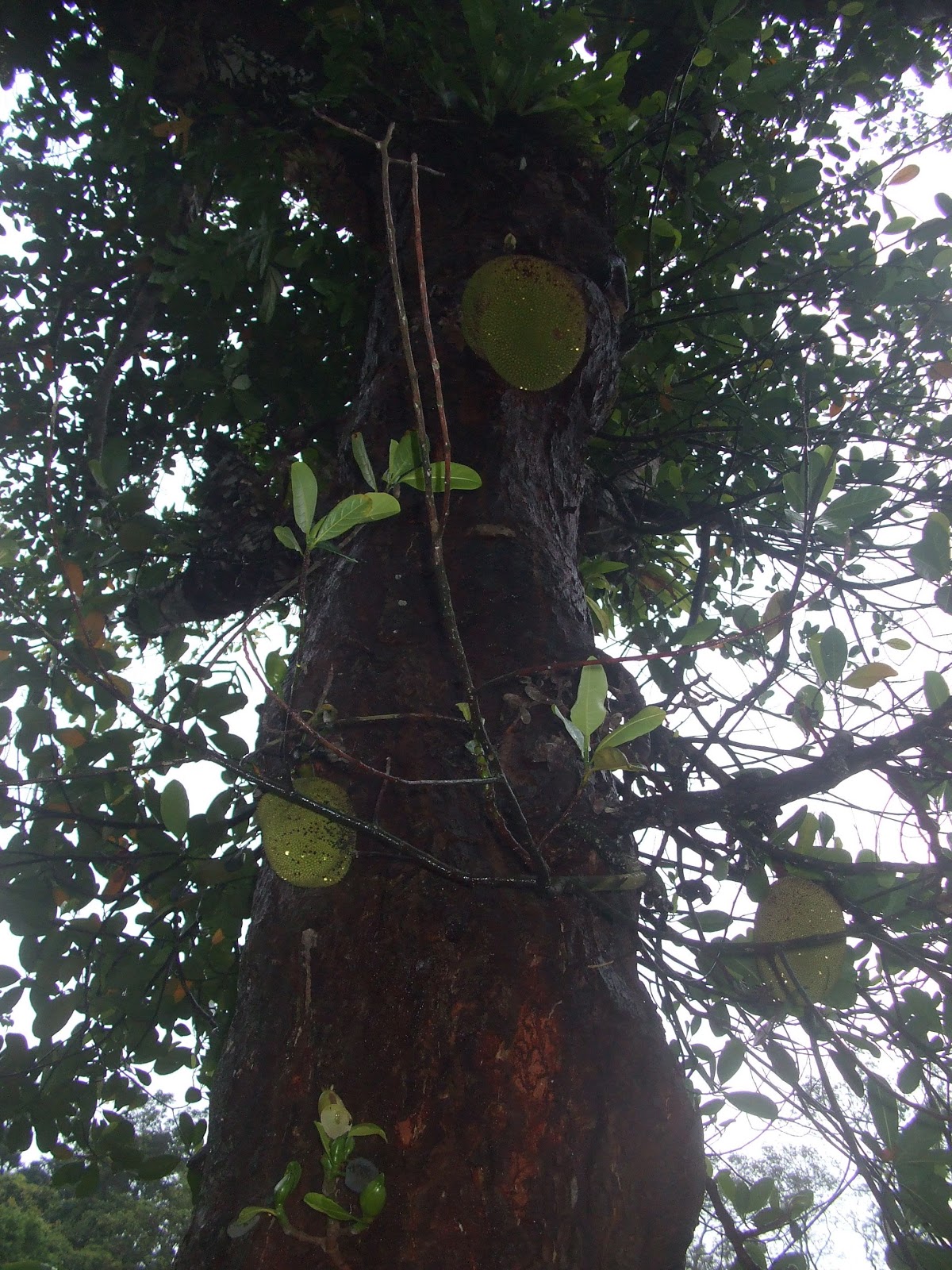
I think everyone knows the first but the second is jack fruit, which I talked about in the last entry.  It has a stronger smell than taste, and you have to make sure not the eat the white parts that people use for glue--not very tasty.  

When we got to the trail and started to go up, and up, and up, I questioned my decision to go hiking many times.  And I wondered at why they would make a trail go straight up such a steep place.  I think it is to preserve the primary forest, but it makes it really unpleasant.  I think there would be a way to do a narrow path around the trees that zig-zags up (it IS called the "Zigi" trail) and still preserves the forest, but there's probably a lack of incentive to do it.  Anyway, we made it, and at the top there is no nice view but there is a giant hole that the Germans dug to hide money.  Or treasure.  I couldn't see the bottom, and there was a strange noise coming from it.  Maybe bats.  

On the way down I was in a better mood and showed it to the lovely, giant tropical trees along the trail.   


At the end of the hike, after going back to the village, it had been an over 6-hour hike.  In uncomfortable rain boots. I took a cold shower and lay down for a long time.  

Here's another picture of a blue monkey, that I saw on the hike too but didn't get a good photo of.  This was close to the guest house I stay in.  


 My guide and I heard a gunshot on our way back, and he said it was probably someone shooting a monkey we just saw for food.  I don't begrudge people for needing to eat, I just feel like number one monkeys are too much like humans for me to ever eat, and two there's not much meat on there anyway, is there?  Seems like they'd be stringy like rabbits.  Most villages I've been to have lots of chickens, goats, and some cows, so I think they'd have enough meat without eating monkeys.


Friday, November 9, 2012

Tanzanian village dress and food

I love the clothes here.  I always thought that if I started dressing like the locals that I would look strange, or it wouldn't fit me.  I'm not used to so many colors!  I'd like to continue dressing this way back home but I think it would only work in the summer months.  I wear a piece of fabric draped over  a t-shirt, plus Aladdin pants.  It's easier to ride on the motorcycle with pants, so I wear these but they are loose so I'm not offending anyone.  Not that I think they would be seriously offended, just this way I blend in more.  


In this picture I just had my hair braided by a nice woman at another guest house here, in the style that many Tanzanian women wear.  It was nice for a day but didn't last the next day.  African hair stays in braids better. The above is not exactly how women dress here, but similar. Most village women I see wear a kanga, which is a skirt made simply from a piece of colorful fabric tied around the waist.  Many of them have quotes in Swahili.  I bought two kangas and one says "God loves those who are patient"and the other one says "Congratulations" and "God bless you".  I chose them for the pattern and didn't know what they said, but I don't mind.  At least it's not like the weird English they have on t-shirts and other things in Asia.    


Here is an example of how some women dress.  They are not necessarily Muslim to wear it this way, it also protects from the sun.  Sometimes I wear mine over my hair, but not usually.  I don't go around like this because I think I'm expected to dress Western or at least differently, so this is just an example. More often than not women will wear two different kangas, sometimes the same.  At the shops they come in two identical pieces.

The men on the other hand dress very western, unless they are Muslim and they wear a cylindrical cap I don't know the name of, and loose pants.  Sometimes in more heavily Muslim places like Zanzibar island they wear a white dress that probably has a name I never tried to find out.  Children are either in a school uniform or in clothes that look like well-played in second-hand clothes.  

Here I am in one of the villages I've been doing interviews.  I usually have lunch in the villages if I'm there for interviews, and sometimes they have treats like jackfruit, which I am about to eat in the picture.                                


That was my first time trying it, and I like it a lot, but right now it's not the season so it;s hard to get a good one.  I don't want to buy a whole one very much either, because they are often bigger than a watermelon.  It was nice to taste.

Here is a full meal that I had in another village.  I asked to try their "cocoyams" which are purplish and a bit chewy, but I liked them.  Some local greens I don't know the name of, plus a banana, and a mug of hot milk, makes a complete lunch.  I think milk is a relatively recent introduction to the area, and more people have cows now as a part of diversifying livelihoods and improving nutrition, or so I've read.  For many people here I think cows have helped them be more independent farmers and not have to work for others as much.


Another big part of livelihoods here is spice farming, which I think I mentioned before.  Cardamom was the biggest earner for awhile, but now I think black pepper is the expensive one.  Here it is on the vine:


The black pepper vine is grown along with a tree called Cydrella odorata, which as the name implies has a strong odor, and I hate it.  But I think it only smells when it is flowering.  But it will hit me when I don't expect it, and I usually don't see the tree it's coming from so I just grumble angrily to myself.  Anyway, growing the two together seems like a good system because Cydrella is a legume, and so fixes nitrogen in the soil as it supports the black pepper vine.  I ate some fresh pepper from the village but it isn't often consumed by the people here, just sold.

I will do another entry about my guided tour of one of Amani's trails, since it won't let me put more than 5 pictures in one blog entry.  


Pangani mini-vacation

I had a nice but short beach vacation in a YMCA near Pangani, a town south of Tanga in Tanzania.  I went with some nice Danish people I met who are volunteering at a place near where I'm doing my field work.  It was just what I needed to clear my head for a few days and re-energize for the rest of my field work.  It was a beautiful beach!


The path down from my room.  My room was a small circular hut that was too hot at night and the fan didn't work, but taking a cold bucket-shower before bed helped with that.  I paid for the beach, not luxurious accommodation.  


That's mine, with the clay-colored roof.  Next to some mango trees that a baboon visited regularly.  

At night I would take a walk over to the nearby cliffs to watch the sunset.  There were some mangrove trees on the way, which made me wonder if they destroyed other mangroves to make a nice beach for tourists, but I never asked.


There were lots of tiny crabs on the beach too.  While laying on the beach (I had SPF 50 on, don't worry Mom!) I threw a small stone at a crab and it ran to the stone and buried it.  I remembered suddenly my Marine and Coastal Ecology from fall semester, where my professor was from Tanzania and told us many things about mangroves, and I remember in particular his story about walking along a beach with another biologist in Tanzania, and he accidentally stepped on a small crab.  The biologist he was with told him to be careful of the crabs, and when my professor asked why the biologist said that the crabs help plant the mangroves.  My professor didn't believe him at first, because he thought mangroves grew where their seeds floated to.  But the mangrove tree has two kinds of seeds, and one of them is small and round and these crabs, who eat things that look like mangrove seeds, grab them and bury them only to forget about them (like squirrels and acorns) and help plant more mangrove trees.  I didn't expect to be able to see it in action, but there it was!  

I didn't take any pictures of the crabs (they were too quick and hard to see with the sand background), so you'll just have to believe me.  I have some cool pictures of freshwater crabs I've seen in Amani for the next post.

I saw some fishermen a few times on the beach where we stayed.  They were doing something with the net (untangling it?) until the light was gone.


They work from before sunrise to after sunrise, which here is always around 12 hours.  The boats look hand carved.  Sorry that the picture is a bit blurry.


 It's not Michigan but they had a nice sunset.


Now I'm back to the daily grind, but now I feel like it's easier. The first month felt like climbing up a hill, and this last month feels like sailing down the other side.  There may be a bump again when I go to Dar Es Salaam for the last interviews, because Dar is a stressful place.  More swindlers, rubbish and traffic.  My translator will be like an escort then, because as a woman of European-descent I have to be careful.  Makes me sad but that's how it is here.  Even my translator, who lived in Dar for 5 years doesn't like it.  There's good and bad everywhere though.


Monday, October 15, 2012

Lists about Tanzania


I thought I'd make some lists of things that aren't so convenient here, and things I like that I think I will miss about Tanzania. 

Difficulties, things I deal with that make me miss home:

1. Washing clothes by hand, hanging to dry, which really sucks in humid weather in Amani!  To be honest though, I have started enjoying the washing part, and if there's good sun I love the smell of my clothes after.  

2. To get hot water, have to flip a switch for at least 30 minutes to warm it up, and some places there was no hot water (which was okay in the hot places, but not in Amani--luckily I have enough here)

3. Buying water in bottles, too risky from tap, much less from streams (miss that about Norway)

4. Not having whole grains!!  In bread, rice, etc.  So sick of white bread.

5. Being a "mzungu" or white foreigner: people staring, shouting random English phrases (kids AND adults)


Nice things, things I will miss here:

1. Great fruit: papaya, mangoes, avocado, coconuts (fresh and mature),

2. Riding a motorcycle on nice roads in Morogoro, and being able to find a motorcycle taxi just about everywhere.  And costs 75 cents  to a dollar to go almost all the places I needed to go.

3. Aerobics class in Morogoro

4. Hot milk in my coffee and tea, and by itself, which I will have to replicate in Norway/MN

5. Monkeys, birds, forest night sounds in Amani

6. Warm weather, beautiful scenery/views

7. Wearing African-style and colorful clothes, and jewelry, some of which I could pull off in Minnesota, but much I would just feel silly (and cold in the winter!) in.  


Wow, I guess I have more good things than I thought.  Oh, and for difficulties, I did the small things--missing friends and family is the worst and goes without saying.  And then I could add in the good list "meeting new people" but that has been really good and really bad both.  


And now a funny story about one of the German colonists in this area I heard from an 88-year old Tanzanian man:

The German man (some kind of governor?) being carried on a palanquin of sorts by locals--this Tanzanian man was young when this happened, and said in concern: "That poor mzungu is sick and too weak to walk on his own!"

I asked if he was also being fanned by banana leaves.  Not this time, but I'm sure it has happened.  This story seems crazy to me that it actually happened, and I met a guy who witnessed it first hand, but in other, more subtle ways, I think colonialism if far from over in Africa.

Finally, here are some pictures I wanted to add last time but they didn't upload:


Tea fields.  Tea fields forever.


Forest in the background of tea fields and one of the nicer roads we drive on.


Hornbills hanging out overlooking secondary growth forest.  Taken from the tallest point in Amani Nature Reserve.

Wednesday, October 10, 2012

In Amani Nature Reserve, Tanzania

I've started my field work now, where I will be spending two and a half months in the Amani Nature Reserve, going to the surrounding villages to interview farmers about losing some (in some cases all) of their farmland to a new wildlife corridor that links two separate parts of the reserve.  I'm also interested in getting more information on the ecological restoration plan of the corridor, and try to interview all actors in the process, including government officials, NGO staff, and biologists who were involved in the process.  I think I won't give out many details other than that until I'm finished with my research, other than funny day to day happenings.

                           
In order to get to each village, from the Conservation Center where I'm staying, my translator who also moonlights as a motorcycle taxi, is also my driver.  We ride a motorcycle over some of the most awful roads I've seen, and they get much worse in the rain.  We've already used 3 different motorcycles (they aren't broken but we tried them until the third was the best) and we have to fix the current one semi-frequently, particularly the chain gets loose.  The first village interviews are done, and I have 5 villages to do.  The first one was the furthest away so thankfully we won't spend so much time on the motorcycle anymore.  I still get kinda muddy though.

                               
The forest here is beautiful, and I even enjoy the farms, where they grow all the famous tropical foods and spices everyone loves, plus some more we don't get in the North, like jackfruit.  They grow bananas, mangoes, coconuts, avocadoes, yams, papaya, cardamom, cloves, cinnamon, black pepper, and other staple crops like maize, beans and cassava.  It's really cool to see all these in plant and tree form.  Cardamom is a tall plant, while cinnamon and cloves are trees, and black pepper is a vine.  I love banana trees the best--they're so tall and the leaves so big and shiny green.  


Cardamom plants in front, banana trees on the side and in back.

For wildlife, my translator is also a guide for the Amani Nature Reserve, and he knows many plants, birds and other animals around.  I've seen hornbills, who look like toucans I guess, at least the cartoon Toucan Sam of Fruitloops, and they whoosh overhead with the weight of a hawk.  Then there's the small blue monkeys who travel in small groups, and slightly larger colbus or black-and-white monkeys.  I have many far-away pictures of blue monkeys, and one of this sweet horned chameleon (below monkeys) that a villager showed me.  


I think this might be the leader of the group.


Maybe the leader, not sure, or the group's yoga instructor.


Thanks, random villager, for the great find!

                               
The hardest part about being here is being alone a lot, especially after being part of a big group for two months.  Takes some getting used to.  I try to joke around with my translator, with some success, but the language barrier makes it difficult.  And cultural.  Today we were waiting for someone to guide us to the wildlife corridor, and my translator sounded frustrated that he didn't show.  I said, well, maybe he had an emergency, like his clove trees were on fire.  For some reason I made myself laugh pretty hard at this, because it sounded so crazy, like "sorry man, I gotta go--my clove trees are on fire!"  And my translator laughed but I think it was maybe not as unlikely a scenario as I had originally thought, as later on we saw some banana trees that had clearly been on fire that day or the day before.  I hope that if I do say something stupid or offensive he will tell me, but people here are so nice I'm not sure.

Thursday, September 27, 2012

Pig Roast and Goodbye


We had an event that I think I will never forget, because there were so many great things that happened.  One of our fellow students gifted us with his great cooking skills and slow-roasted a 10-kilogram pig (I weigh about 60 kilos, for scale) for 6 hours, periodically seasoning and spraying beers on it.  It tasted amazing.  The whole night was amazing.  


I used some of the coals to make a potato, carrot, onion, garlic, rosemary and olive oil side dish wrapped in foil.  And we made a salad of other vegetables we got at the market.  

We saw a chameleon in the bushes near where we had the fire, standing absolutely still.  Late in the night we saw it again and it was still white, the same color as a plastic bag nearby.  Adaptation?


I kept thinking, as we sat around the fire after eating, this is one of those timeless activities that human groups have done since humans existed.  This is it.


Five people representing five countries.  Sometimes I think if we set our minds to it and didn't have so many pig roasts, we could save the world.


Enjoying a "Safari" in front of the fire.

Our awesome chef.


Cutting the roast.  We shared some with the owners of the outdoor bar and grill, for being so cool and letting us roast the pig there.


After dinner conversation.  The guy second from the left was our guide up the mountain two times, once halfway and the second time all the way 2090-some meters to the top of a mountain nature preserve.  There were monkeys!  But I only saw them from far away.  He brought his friend to our feast--I'm so happy we invited them.


At the end of the night, we all ended up spontaneously dancing to some great music, in a big circle with all of us plus people who worked at the outdoor bar.  It was such a fantastic night.

Now, the group trip has ended, and many of us have gone off to do our individual field work, after a short respite on a really nice beach close to Dar Es Salaam. It was hard to say goodbye to everyone, but I'll look forward to seeing most of them in Norway.  We'll have to get together and fight international injustices and save the planet!  But first we will have another pig roast, I think.  It takes energy to save the world!

Now I'm staying in the Forestry department's guest house here in Morogoro, and I will get up early tomorrow to go to the Amani Nature Reserve, where I will do my field work.  I've had a great introduction to Tanzania, and I only hope I can work hard enough to make up for how fortunate I've been to come here and be shown around by such friendly and giving people.